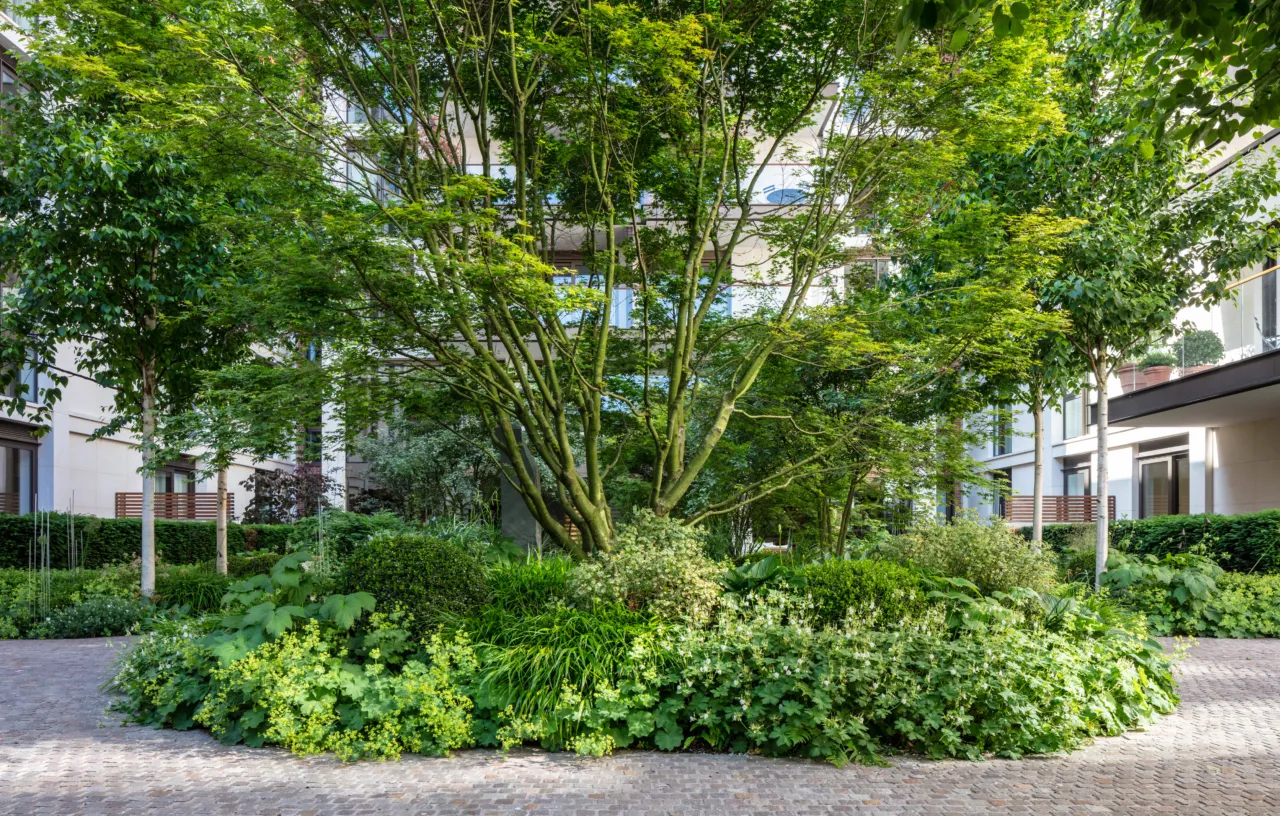
Designing for the weather to come

The last four years have been in the UK's top five warmest on record, and in 2025 London experienced four official heatwaves and more than 120 wildfires, the highest rate since 2022 when temperatures exceeded 40°C. Professor Geogina Enfield from the Royal Geographical Society says nothing we see now is unprecedented. She has been studying farmers diaries and local newspaper reports from the late 17th into the early 20th century to map the occurrence of extreme weather events. She has seen a surprisingly regular pattern of tornado’s, floods, droughts and harsh winters that have caused catastrophic damage to local communities and places. Her research also shows the resilience in both social and natural infrastructure to resist long term damage, because the intervening periods between these weather events allowed time for regrowth, rebuilding and regeneration.
A critical impact of climate change in the 21st century is the increase in the frequency of these extreme weather events and with that a markedly increased stress on our plant kingdom, social and built infrastructure to continue to bounce back. The natural world is in a state of continual adaption through mutation and selection in order to respond to changes in the environment, but this takes eons and these processes simply can’t keep up with the rapidity of temperature rises we see now. Our built infrastructure isn’t adapting fast enough either, and our urban model for street patterns, open spaces, squares and parks can be traced back for centuries and is designed around movement, character and experience rather than shifts in climate. The human cost is also real: scientists estimate the June to July 2025 heat in London caused around 260 excess heat-related deaths, of which roughly 170 can be attributed to climate change, effectively tripling the toll.
What does this rapidity in extreme weather pattern mean for landscape design. The history of landscape architecture and garden design has relied upon a consistency in plant habit, growth, succession and longevity. Capability Brown designed estates for a wealthy elite who had the supreme confidence that their lineage would maintain their landscapes. His beautiful bosques of oak were purposely planted to outlive the client and serve future generations. Cities too became synonymous with a single tree species; Copenhagen for its Elm trees, London for its Planes and Berlin for its Linden’s. Exotic species appeared within the design palette because they were novel, unique and fashionable, not because of any environmental factor. In urban development the introduction of trees and plants was to beautify and order space and make reference to a wider natural world beyond the city boundaries, not as a reaction to changes in the weather.
As landscape architects we can no longer share that confidence in consistency. Extreme weather events have alerted us to a far more fundamental aspect of landscape and planting design and that is simply the preservation of life.
Cities feel this most sharply. Streets and parks were never built for these extremes. Higher urban temperatures are caused by the increased capacity of roads, buildings and pavements to absorb and trap heat, leaving towns and cities noticeably hotter than the surrounding countryside, particularly at night.
New forms of adaptation to manage urban heat risk is essential to deal with climate impacts that are now locked in because of historic emissions. One way to reduce that risk is to increase green and blue spaces that use plants and water to provide natural cooling. Trees do particular work here. Increasing vegetation lowers near-surface air temperatures through shading and evapotranspiration, and trees matter most because their canopies shade and they transpire more than low planting. The scale of that contribution is measurable: London's urban forest is estimated to have avoided 153 heat-attributable deaths between 2015 and 2022, and increasing tree coverage in line with the London strategy would reduce heat island mortality by a further tenth.
But planting the same species of trees we have in our cities is not the answer, and this is the harder truth for our profession. By 2090, forecasts indicate that up to 73% of London's public trees may not survive or thrive under future climate scenarios, while only a fraction of a percent of current species are highly suitable. The species that have defined the British urban form for centuries may not be the species that shade it in fifty years. This means moving beyond tradition, preference and legacy planting lists, and instead grounding decisions in climate modelling, species distribution data, soil moisture projections, and physiological thresholds such as drought and heat tolerance.
Kevin Martin, Head of Trees at RBG Kew is using digital mapping to find areas around the world that replicate what the British climate will be by 2040 and then investigate the ecotomes and tree species that flourish there. His conclusion is that many trees we as landscape architects traditionally like to use such as beech, lime and birch will not survive into this future. Instead reliance should be made on Carpinus orientalis, Zelkova serrata, Quercus x hispanica and Parrotia persica which flourish in hot dry conditions. If so we have to accept our open places will look and feel very different to the ones we know now.
Our view at Gillespies is that this reframes the designer's task. We are not choosing plants for the climate we grew up with, or even for today, but for the conditions a landscape will meet at maturity. This is a significant shift that demands a carefully researched palette. Climate-resilient planting has to tolerate drought, heavy rain, mild winters and late frosts at once, which is why Mediterranean species handle drier summers, deep-rooted perennials survive both drought and waterlogging, and hardy natives cope with variable conditions. The point is not to swap a wet-climate garden for a dry one, but to design for both extremes in the same scheme.
It also changes how water moves through a site. Swales, rain gardens and permeable paving capture sudden heavy rain and feed it into planting rather than the drains, while trees, shrubs and perennials create shade, reduce soil temperatures and shelter more vulnerable plants. Diversity itself becomes a form of insurance. Diverse planting layers help wildlife and spread risk if one plant group fails under climate stress.
There is a caution worth holding. Britain is not the Mediterranean, and importing that logic wholesale is a mistake. British soils retain a depth of topsoil from a temperate past that makes conditions very different from the arid Mediterranean, and UK droughts tend to last weeks rather than months. Judgement based on adapting to spatial and physical conditions found here, not fashion, should decide what goes in the ground.
The practical implication for clients, boroughs and designers is a shift in how success is defined. It means treating urban trees as essential infrastructure rather than ornamental features, diversifying species, prioritising resilience in procurement, and measuring success through survival and canopy growth rather than simply counting trees planted.
Designing for heat is not a departure from what landscape has always done. It is the same discipline, asked to think generations ahead, and to plant for a country that is quietly and systematically becoming somewhere else.